Getting in the (Masala) Zone

Wednesday, September 17, 2008
London

Having heard so much about Masala Zone, I decided to check it out tonight with Chriselle’s London-based colleague Ivana. Chriselle had made the cyber introductions between us because she really hit it off with Ivana when she met her in New York a while ago–and I can see why. Ivana is sprightly, bubbly and so cool she rides a bike all over London–even to biz meetings. She rang the doorbell at my Holborn flat at 7 sharp as she had said. (I discovered this evening when both Shanaz and Mukkaram and later Ivana arrived and buzzed me from the main door, that my buzzer does not work. I had to get down to the lobby to let Ivana in.

She loved my place (what’s not to love, right?) and envied me royally both for the location and the layout of the flat. Then, we were out the door, walking in the brisk evening air towards Covent Garden. I suggested Masala Zone and she was game, loving Indian food as much as she does. Poor relation to Amaya, Veeraswamy and Chutney Mary, Masala Zone offers “Indian street food” such as chaat but we decided to try the “regular thali“. I went for the Karwari Prawn while Ivana chose the Lamb Malai.I realized as I broke the first piece of my chapati that I haven’t eaten desi khana for at least a month and I salivated as I sank my fingers into the curry, two sabzis, dal and chutney, and crunched into my papad. Every item was delicious and at under 9 pounds for the lot, I thought it was very good value for money. The chapatis were soft and hot and with the Tiger beers we ordered to wash the meal down, we did very well, I think.

Since the night was young, Ivana suggested we move on to a pub for another drink and in the shadow of the mammoth and very impressive Royal Opera House, we chose the Nag’s Head Pub where Ivana suggested I try the Stella lager, a Belgian Beer. Though already stuffed, I managed a bit more beer and conversation without falling asleep for the heavy meal and the drinks had served to lull me into a stupor.

The day had been productive. I went to our Bedford Square campus for a meeting with our IT specialist Lucy Appert who was visiting from our New York campus and who trained me as an administrator for the running of our newly created Economics blog. I got back home to do a fair amount of work on my research project and get ready for my classes tomorrow.

Shahnaz called to say that their move from the Holiday Inn to the hostel at Brunel University where her son Hassan has been admitted was delayed. Our intended walk in Chelsea was cancelled and when Shahnaz and Mukkaram got to my flat with only 20 minutes to spare before the curtain went up on their show (Mamma Mia) at the West End, they literally used the washroom and galloped right out. It was a day of many disasters for them and they were not happy campers.

It’s back to class for me tomorrow as I tackle a work load that is embarrassingly light–but I’m not complaining.

Oh, I forgot to mention that my friend and Professor of Victorian Literature Margaret Loose of the University of California at San Diego will be here tomorrow to get some research done at the Rare Books Section of the British Library–so naturally, she got in touch with me via email to tell me of her plans and now I will need to spend some time with her.

I really have to stop meeting all my friends this way!!!

A Day Out in St. Albans

Tuesday, September 16, 2008
St. Albans, Hertfordshire

I had heard a great deal about the lovely little town of St. Albans. When my friend Shahnaz Bhagat arrived in London last night with her husband Mukarram and suggested we spend the day together, I thought immediately of getting away from the city and catching up with them in a charming medieval town that Time forgot. They were sporting enough to place themselves in my hands and we were off, meeting at King’s Cross and taking the Capital Connect train to the hamlet. To our enormous surprise, we got there in under fifteen minutes on an express train that took us past miles of bright green fields into the country.

Because they hadn’t eaten breakfast, we made a bee-line for the Tourist Information Center in the middle of the Town Square to inquire about the location of the nearest restaurants. The little research I had done last night, by consulting my guide books, had pointed to a pub lunch at Ye Olde Fighting Cocks, reputed to be one of the oldest pubs in England and dating from the 1200s. So off we went, past the handsome Clock Tower whose vivid blue face and golden figures proudly proclaimed the hour. A delightful walk past St. Alban’s School for Boys took us towards the ancient stone walls of the city and the handsome facade of St. Albans Cathedral all of which breathed history through its aged stone.

But because our tummies beckoned, we pressed on, strolling along serene country lanes past old homes whose cottage gardens were still full of late summer blooms. The Pub was picture-perfect and before long, we were seated in its darkened interior being waited on by a cute and very obliging bar tender named Nick who took our orders for his best draft lagers. As we nursed our drinks in the shadow of a giant Ingelnook fireplace, we took in the low-hung beams on the ceilings and the aged furniture. The place had a venerable dignity and we were so glad we chose to have a meal there. Though it took frightfully long for our food to arrive at our table, we gladly excused the long wait as everything was superlative. We ordered the Chicken Breast which came with a basil mash and baby carrots, the Rib Eye Steak with a balsamic vinegar gravy and perfectly done chips and the grilled hake with a crab mash, the most succulent aubergines and caramelized red peppers and a dressing make with garlic-flavored spring onions. Every single item we tasted was exquisite and though we were stuffed, we could not resist ordering a dessert that we decided to split–a wonderful Sticky Toffee Pudding that swam in warm caramel and was served with custard. I am convinced that pub food in England is not what it used to be–leather-like meat and overcooked vegetables. With so many of them having become gastropubs, the pressure is on to produce mouthwatering menus and the end result is satisfied customers who can look forward to excellent meals as part of their tourist experiences.

Replete with our repast, we went out to embrace the city striding across the Verulamium Park (the Roman name for the city) towards the Cathedral which, of course, we had to visit. Indeed, the stone carved altar was breathtaking as was the Rose Window and other stained glass. Today, the Cathedral also houses an Abbey Church among whose treasures are a copy of the Magna Carta (though this is not for public display). Amazingly, the roses were still aboom in the gardens outside and their fragrance quite beguiled us as we walked by.

Then, we followed Fishpool Road towards the quaint Village of St. Michael where the raised footpaths spoke of times past when the villagers’ only form of transport was horse-drawn carriages. The raised footpaths, almost like platforms that lined one side of the street, enabled ladies and gentlemen to alight easily from theor carriages and enter their homes whose doors were brightly colored and adorned with interesting knockers.

Then, on we pressed arriving at the Kingsway Watermill, an ancient building that ground corn in the Middle Ages and continued to do so until very recently. In fact, it is still a working mill and today grinds feed for cows, horses and pigs. A really heartwarming restaurant called The Waffle House has sprung up on the old premises and after we had toured the fascinating museum and seen the great big wheel that turned the mill as well as the equipment and instruments used by the millers of a past era, we could not resist ordering one of their dessert waffles for tea. It arrived at our table–a pecan studded waffle, swimming in a creamy butterscotch sauce and served with a dollop of vanilla ice-cream. It is difficult to express in words exactly how marvelous this concoction was and had we but space, we would easily have consumed one each–good job we ordered just one and split it.

Then, fortified enough to tackle some more walking, we strode past a busy road that carried traffic towards nearby Luton airport and arrived at the ruins of the Roman Theater. The Romans had made the town their base and named it after the River Ver that flowed by its banks–the same river that allowed the watermill to function. Having seen the area being grazed over by flocks of placid sheep, we backtracked, arriving at the Roman Museum, which being past five ‘o clock was closed. This left us enough daylight to cross the Verulamium Park past a lake filled with ducks and geese and the remains of an old Roman Wall and brought us back to the pub and then the town center. School boys wearing their jackets and ties poured out of their school at the end of another day and brought much vibrancy to the main square which was lined with trendy stores and restaurants.

St. Albans is named for an early Christian martyr, for after the fall of the Roman Empire, the town was taken over by the Saxons who brought Christianity with them and ended up converting it into a pleasant rural hamlet. The combination of Roman and Saxon history, the charm and antiquity of its outlying villages with their sagging roof lines and tottering beams, brings to the area today a rare opportunity to experience life as it might have been lived in England in past centuries without venturing too far away from the heart of London.

We truly had an unexpectedly memorable day and I am so glad that I was able to explore this town in the company of some of my dearest friends who also happen to appreciate these outdoor spaces as much as I do.

Feeding the Homeless at Lincoln Inn Fields

Monday, September 15, 2008
London

I woke up to the realization that I have spent exactly one month in the United Kingdom–certainly one of the happiest and most exciting months I have ever spent. My entire life at this point seems like an endless vacation and I am reveling in it.

It still feels strange to wake up alone in the eerie silence of my flat and not have Llew’s quiet presence surrounding me. But most days we speak on the phone just when his day is beginning in New York and mine has reached its middle and then it seems as if he is right here besides me. He too seems to be going from one vacation to the next–we’re already talking about a possible trip to Greece in November when he comes back here.

Today I got down to planning logistics for my Anglo-Indian research project. Worked on the PC all morning, drafting introductory letters and making arrangements for my research position at St. Antony’s College, Oxford, next summer. Before I knew it, it was time for lunch, then more email correspondence.

At 4pm, I left for my excursion to Marble Arch to get my cell phone fitted with a new Lebara SIM card which is far more economical than the one I am currently using . But the sweet Indian girl Pooja who attempted to fit the card in, found that my phone was ‘locked’. Her attempt to unlock it failed and the guys to whom she sent me told me that it would take them 2 hours to reformat and reprogram my phone. I did not have that kind of time so declined their offer and left.

Pooja then suggested that I go to T-Mobile and have them unlock it for me. The trek to Oxford Street from where I had purchased the phone drew a blank as the sales assistant told me that they do not have the authority to unlock phones. However, she sent me across the street to a really smart guy called Sajjid who was able to do it in exactly five minutes! He was also able to give me a Lebara SIM card for free except that he did not have one that would allow me to fill it with any money as he had run out of them. He has called me back tomorrow but the earliest I can get there is Friday and I shall make sure I return to him and have this Lebara SIM card fitted.

Then I was at Bedford Square for our first faculty meeting of the year. Had a chance to meet a few of my London colleagues and over a few tea sandwiches and delicious cake, the meeting got under way, chaired by David Hillel-Ruben. Things moved along swiftly indeed and in less than an hour and a half, we were out.

I walked as quickly as I could to Lincoln Inn Fields to meet Subita Mahtani to whom I had a phone introduction a few months ago through a mutual acquaintance named Leslie Mahtani in Connecticut. Subita, an NYU alumnus who has lived as an American ex-pat in London for several years, is involved with a social service operation that provides food to the homeless three times a week. Because she takes charge of the Monday operation at a location close to my flat, she told me to meet her there. In-between doling out ladles of dal and rice, she hugged me, welcomed me to London and exchanged phone numbers with me, assuring me that we would meet again at length to get acquainted.

I was stunned at how many homeless men turned up for a free meal. One of the guys even complimented Nitu, one of the volunteers, telling her that “the curry is very nice”. There was tea and coffee and soda at another station and Mars bars, donated every week by a man who gave up smoking and spends the same money on Mars bars that he would have spent on cigarettes which he then distributes to the poor and needy. Subita informed me that this operation has gone on for years and word of mouth has brought over a hundred homeless people to the corner of Lincoln Inn Fields where, in the shadow of the courts and legal chambers, some of London’s poorest people are fed by immigrant Indians whose generosity and compassion knows no bounds.

Thanks to Subita, I saw a side of London that would otherwise have passed me by. I am grateful to her and inspired by her dedication as well as that of my fellow-Indians in this city. Each time she handed out a plate of food or answered a question, Subita said, “God Bless You”. This caused one of the recipients of her caring to remark, “You speak like an American”. Perceptive guy, that one!

Chores, Chores and More Chores

Sunday, September 14, 2008
London

Today was a day to get down and dirty–with chores, I mean. Started the day catching up on email that had accumulated over my two day weekend trip to Stonehenge and Bath.

Caught Mass at 10 am at St. Anselm and St. Cecilia’s at Lincoln Inn Fields and made friends with a parishioner called Karen Harris who happens to be from Los Angeles and is married to an Englishman! She walked me to the church when I was unable to find the entrance and before I knew it, we were chatting and exchanging phone numbers. Only an American would give you her number so readily and be so willing to make a new friend! I look forward to many happy times with her.

Then, the chores began. First, groceries: off to Tesco, then to Sainsbury Central (which was closed–only opens at noon on Sundays), then to Sainsbury Local which did not have half the things I wanted, so off to Marks and Spencer Simply Food. Luckily, all these places are only a stone’s throw away from my flat but I was weighed down by the time I got home and began cooking.

And did I cook up a storm! Salmon Provencal with Olives and Herbes de Provence; Salmon with a Mustard Sauce and Spinach-Pistachio Crust; Chicken Pepperonata with red, yellow and green peppers and lots of oregano; Broccoli Cheddar Soup; Thai Green Chicken Curry; Sweet and Sour Vegetables; Spinach with Lemon and Garlic and a batch of Pork Sausages! By the time I froze half of everything I cooked and cleaned the kitchen, I was so tired…but then I had laundry to fold after the big batch I put into the washer-dryer last night.

Spoke to Llew twice today, to Chriselle once and had a long chinwag with my parents in India. Also spoke with Gauri whom I finally got on the phone and with my relative, Cissy, who is just back from Canada. Caught up with everyone’s news, realized that despite making new friends and being so busy, I am spending a great deal of time alone. But I am living fully in the moment and soaking in the experience in its entirety.

I spent the evening creating new web pages on our Travels in Yorkshire…after which I was ready for a long bath, some dinner and an evening in front of the telly which I felt I fully deserved. And with the first part (of three) of the new BBC One remake of Thomas Hardy’s Tess of the D’Ubervilles, I vegetated with a big bowl of ice-cream and fresh strawberries, blackberries and figs and enjoyed the evening away.

Just when I thought I would call it a night, the sky exploded with a gazillion showers of golden stars as fireworks lit up the ink-black sky. It was like July 4 celebrations from my window and I marvelled at the sight and the sound as for the next 20 minutes, the mood was joyous!

Stonehenge and The Golden Georgian City of Bath

Friday and Saturday, September 12 and 13, 2008
Stonehenge and Bath

In all my travels in the UK, I have never been to Stonehenge. Avebury many years ago, yes, Stonehenge never. So, it was with anticipation that I arrived at this ancient site of mammoth sarcen and blue stone hoping to grasp at some of the mysteries of its creation and its significance. I left disappointed–in that I was able to understand neither. However, the aura of the place, the fact that so many centuries after it was created, so many tourists stopped there to encircle the wide grassy path and make something of the structure intrigued me and by the time I was halfway through the circle, I was awed too.

In and of itself, the ring of Stonehenge can seem like nothing more than just that–a ring of stones. But when you consider the massive effort it took to get those stones there from faraway Wales, the end-product is breathtaking in the same way that the Pyramids of Egypt are. By the way, the story about Druids creating the ring and coming there each year for ritualistic worship of the elements has been disproved. However, there is enough astronomical precision in the way the stones have been placed and the way the shadows of the earth and the sun lengthen and criss cross one again at strategic points for us to know that this was not a spot chosen at random nor was the placement of the stones a mere whim. There is enough scientific evidence to suggest that ancient man had a method to his madness and this is what makes the site enthralling.

On a humorous note, it was fun to see more teenagers take pictures of the sheep that went about their business, i.e. grazing on the pasture that surrounds the spot, than of the monument itself! But, as they say, there is no accounting for taste… or interest!

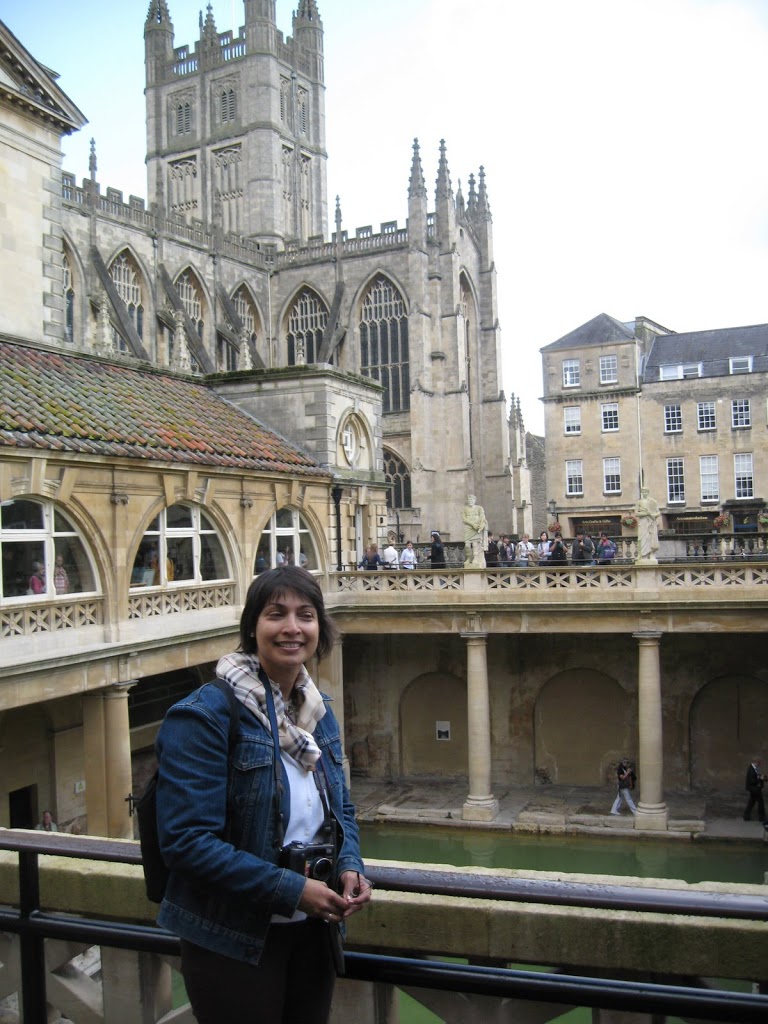
Then, we were driving on the wide and picturesque Salisbury Plains past the Weston Horse, a great engraving on a white chalk cliff, to arrive in the golden Georgian city of Bath that is, like Rome, perched on seven hills. No wonder the Romans embraced it and built a splendid city here over 2000 years ago. As if the location were inadequate, the Romans who came from a balmy and sunny clime to invade this cold and rainy little island, felt rewarded by the warm and abundant waters gushing from the earth and promptly named their new settlement Acqua Sulis dedicating the resort to the goddess Minerva. Given their penchant for communal bathing, the town became a spa especially as its muddy waters were said to have cured King Bladud (father of Shakespeare’s King Lear) of leprosy. Well, the rest, as they say, is history, and Bath has a fair share of that stuff.

On the many occasions that I have been to Bath, I have always gone on horseback–well, not literally, but what I mean is, in a hurry. I’ve combed the main sights–the spectacular fan vaulting of the Abbey, the romance of the Roman Baths, the elegance of the Pump Room with its Jane Austen and Beau Brummel associations and have posed by Pulteney Bridge…and then I was off.

This was the first time, I stayed in the city long enough to be able to embrace it as the Romans did. And I left with an affection for the city that I had never felt before. Walking through its golden streets–golden because the entire city is constructed of the famous warm honey-colored Cotswold stone with which the city of Oxford is also built–I felt a rare delight in the sheer uniformity of the color and the style of the buildings.

The entire city was designed and constructed by the father-son duo of John Nash–since they both had the same name, they are distinguished as The Elder and The Younger. Their love of classical architecture and clean Roman lines is evident everywhere you turn, from the Royal Theater which Jane Austen frequented (where I felt so fortunate to get a seat unexpectedly to watch Vanessa Redgrave play Joan Didion in The Year of Magical Thinking, an account of Didion’s grief-management when her husband John died while her daughter Quintana lay in a coma), to the Crescent (a semi-circle of plush mansions) to the Circle, a perfect circle of colonnaded homes built around a park, to the Assembly Rooms where the rich and famous gathered to dance, discuss community affairs, gossip and make matches, to the fashionable Pump Room where they basically did the same thing while sipping the medicinal waters of the hot spring–which I did too and found to be foul-tasting but warm.

On a past occasion when we had arrived as a family in Bath, Llew and I had attended a cocktail party in the Roman Baths, lit by giant fire torches at night, and had supped to the accompaniment of a classical quartet in the candlelit Pump Room–this was part of the recreation provided by the organizers of a conference at the famous University of Bath where I had presented a paper. This time, I was a tourist, with map and camera in hand, clicking away at the many centuries of history and architecture that lay ensconced in that one space–the Baths–and at the many lovely arches, crescents, bylanes, towers, steeples, bridges (I actually walked on Pulteney Bridge, this time, only one of two bridges that is lined with shops–the other being Florence’s Ponte Vecchio).

I also visited the Jane Austen Center (I mean how can you escape from old Janie when you are in Bath?) and saw costumes from a range of films in which her novels and her own uncomplicated life have been portrayed. I went to the Assembly Rooms and saw the Costume Museum, a wonderful receptacle of clothing through the ages. I also visited No. 1 Royal Crescent, a home that has been turned into a museum created to look exactly the way an interior of a privileged home night have looked when Bath was at the height of its popularity and appeal.

I strolled in the same gardens that Jane Austen and her family loved, saw her homes on Gay Street and Queen Square, window shopped in Milsum Street (reportedly the favorite shopping venue of Princess Diana) and in the covered Guildhall Market whose heyday had been the time of the Regency. I had looked forward to browsing through Bath’s many antiques shops but alas, the recession in America and the fallen dollar has affected the UK’s antiques market so badly that dozens of the shops along Antiques Row have closed down. However, I did my share of poking around a few multi-dealer locations and saw nothing to catch my fancy.

I could not leave Bath without doing two things: tasting the famous Bath Bun, a roll studded with raisins and stuffed with sugar cubes and visiting Sally Lunn’s establishment which also happens to be the oldest house in Bath, dating from Roman Times–or so they say. Inside, you listen to the story of a French Huguenot woman, escaping from persecution in the 1600s who arrived in Bath and set up her bakery. She began to bake a bun that was unlike anything the English had ever eaten–brioche-like, this soft confection stole their hearts away and the Sally Lunn Bun was born. Today, you can eat in or take out–a bun costs a pound and a half–and was the best little souvenir I took out of the city. Oh, but I forgot…my favorite souvenirs of the city were the genuine old coins I bought at the shop run at the Roman Baths. These coins from a bygone Britain included florins and half-crowns, farthings and shillings and a whole set of genuine copper pennies, one each from the reigns of all the monarchs that have ruled England in the 20th century, i.e.Victoria, Edward VII, George V, George VI and Elizabeth II. I intend to set these in silver and create an exquisite bracelet and necklace for myself.

I could not leave Bath without attending a rugby match, for Bath’s team is famous and superior to most, and I was able to catch a match in progress while standing on the lovely Pulteney Bridge and watching the teams as they moved in and out of my line of vision.

At night today, especially on weekend nights, Bath buzzes with a plethora of young people from all over the world who frequent its many pubs, clubs and restaurants, then get home sozzled and swaying along its uneven cobbled streets. The low lighting reminds me of the gaslit days when equally sozzled young dandies returned home from the gaming tables and fell drunk in their beds, attended, the next morning by their long-suffering servants. I caught a glimpse of this side of modern-day Bath as well on the late night stroll I took through the city and I was grateful to return to the comfort of my bed at the Travelodge just off Broad Street, where I awoke the next morning to streaming sunlight and the start of one of the first truly sunny days I have had in England since my arrival here.

Pho in Clerkenwell with Karen

Thursday, September 11, 2008
London

When I called out the roster this morning in class, I did realize it was September 11–that dreadful date that, were I teaching in Manhattan, would have caused me to pause and recall events of seven years ago.

Here, in faraway London, however, we spared a passing thought to the tragedy that changed all our lives, then got down to the business of our class on Anglo-India in the 17th and 18th centuries.

In the evening, in-keeping with a ritual that Karen Karbeiner (my colleague from New York who is also going to spend a year teaching in London with me) and I have decided to initiate, we met at a Vietnamese restaurant in Clerkenwell called Pho. Karen informed me that the correct pronunciation of the word is ‘pha’ with a very short ‘ah’ sound!

I was tempted to order pho, which I love–a great big bowl of steaming broth with rice noodles and a variety of meats, served with crisp raw bean sprouts, springs of mint, lemon juice and roasted peanuts. Instead, because I am still on a low carb diet, we ordered a variation of it with a very small quantity of noodles and a lot of greens–healthy, hearty and very delicious indeed.

Karen and I spent the evening catching up with our respective research interests and our plans for the weekend. She, a very respected Whitman scholar, is off with her husband Douglas, A Renaissance Drama scholar, to a Whitman gathering in Bolton in Yorkshire followed by a weekend’s jaunt in the Dales. I told her that a visit to Castle Howard is a must.

As for me, I am off for a weekend jaunt myself–to Stonehenge and Bath and, no doubt, will have some interesting episodes with which to update this blog when I return.

Until then…here’s to memorable travels!

A Walk in Southwark and a Play at the Globe Theater

Wednesday, September 1o, 2008
London

The sun finally peaked out today making a guest appearance during what, Londoners tell me, has been a dreadful summer on the whole. Of course, this rarity would have to occur on the one day in ten whole days that I had to stay home to prepare for my classes for tomorrow! Still, I can’t complain. I managed to salvage much of the warmth and light by working hard all morning at my desk making notes for my classes and adding new pages on our Scotalnd trip to my website.

Felcy came to meet me this morning. She is to be my new cleaning lady and will come in to do my domestic chores on Fridays. I was almost certain she would refuse to accept employment with me as I need her for such a short time only every other week. But I think she was delighted to find a compatriot in London–we can both trace roots to South India, she to Goa, me to Mangalore–and wanted to oblige. Also, she was recommended to me by a family friend whom she holds in high regard and for whom she has worked for years. So, it was all settled then and she will relieve me of the bulk of my chores. She seems cheerful and companionable and, thankfully, speaks perfect English. She also seems to know what needs to be done without being trained–which is a big comfort to me.

Today was also the day my first 2 movies arrived from LoveFilm which is the UK equivalent of Netflix. I picked them up from my mailbox this evening and hope to take full advantage of the free 30 day introduction they have given me. If this arrangement really works, I shall continue to pay them 12. 99 pounds per month to receive 2 DVDs at a time–unlimited. As it has turned out, I have been so busy writing, that I have hardly found any time for TV movies.

Lunch done and with my tickets having been booked for the 7.30 pm performance of A Midsummer Night’s Dream at the Globe Theater, I decided to take one of those lovely walks in London as delienated in the book 24 Great Walks in London. This one is entitled “Bards and Bawks in Southwark”–pronounced “Sut-erk”. It was a two hour walk that began at Borough Tube Station and ended at London Bridge Tube Station. I gave myself a spare half hour at the Theater to enjoy a hot chocolate before the performance began.

As with all these walks, I realize that each time I set out I am in for a treat. I passed three churches–St. George the Martyr, the grand Southwark Cathedral, the oldest Gothic church in London (Shakespeare, Gower, Marlowe, Dickens–all worshipped here) and St. Thomas’ Church which was under heavy renovation and closed. I also saw the remains of the Marshalsea Prison in which Dickens’ father, John, was imprisoned as a debtor–an experience which so traumatized Dickens and was the subject of his prison scenes in Little Dorrit. In fact, the entire area is steeped in Dickens’ memorabilia. There is a Little Dorrit Playground and Court across the road and the Southwark Public Library has fascimile scenes on the wall of the first illustrated pages of the novel.

Southwark also had a totally delightful hidden garden called the Red Cross Garden created in the later 1880s by Octavia Hill from what was a paper factory, in her determination to create open play space for the poorest children of London’s south bank. The garden and the cottages that border it are adorable and I was amazed at how well it has retained its original objective. The space was full of the last roses of summer, an abundance of lavender–most drying on the bushes–bulrushes in a pond and catmint. Neat pathways allowed charming strolls and a couple of people sat on benches chatting amiably on what was a lovely afternoon indeed. But for the most part, the garden was deserted–a fact that added to its serene ambience.

Just a few steps away was Cross Bones, a cemetery for the prostitutes from Southwark’s brothels who were forbidden a decent burial in consecrated ground. The hypocrisy of Renaissance and Victorian Christian society was brought out in the callousness with which these women were treated. Forbidden by the Bishop of Winchester to be blessed in death, their professions were, in fact, licensed by the church! As time went by, this cemetery was used to bury paupers, the nameless dead. Today, it has been turned into a shrine by which to remember the poorest of the poor, those whom Time forgot.

Across the street, I arrived at Maiden Lane, the street on which the original Globe Theater stood in Shakespeare’s Time. Careful archeological digs have revealed some remnants of the original theater which have been carefully preserved and the area cordoned off from any future development. Just a few hundred meters away is the new revived Globe Theater, built through the efforts of American film-maker Sam Wanamaker who subsequently passed away. The gradual gentrification of Southwark means that droves of tourists are pouring into a part of London that received few visitors until ten years ago.

Today, the neglected, crumbling buildings of the neighborhood are being revitalized through modern housing projects that cost tens of hundreds of pounds. I was fascinated to walk through the former Bear Gardens where, in Medieval and Elizabethan times bear and bull-baiting tournaments were held–a bloody sport that fired the public imagination and was extrememly popular. I also passed by the old Rose Theater which staged plays by Ben Jonson and his contemporaries. Indeed, this part of Southwark was a cultural hothouse in the days of Elizabeth I and it slowly seems to be attaining that level of theatrical and cultural proficiency again.

Past The Globe, I saw the Clink Prison, the oldest remaining medieval prison in London and the remains of the Palace of the notorious Bishop of Winchester who, as can plainly be seen, lived a luxurious and lascivious life. Just a few steps ahead is a replica of The Golden Hind, the famous ship of which Elizabeth I knighted Francis Drake for his solo circumnavigation around the world. This brought me directly to Southwark Cathedral where the altar was recently refurbished and freshly gilded and looked stunning. (I had seen only glimpses of it shrouded under scaffolding when I was last there this past March with my friend Amy Tobin). I passed the famous Borough Market, England’s most famous food emporium and crossed over on to Borough High Street towards St. Thomas Lane where at the Church of St. Thomas, the Angel of Mercy Florence Nightingale worked as a nurse in an operating theater that is today, like the Clink Prison, a museum. I am stunned by the number of buildings that have been reconstructed and turned into museums. No matter how small they are, they are still receptacles of curiosity and of an epoch that is fascinating in its antiquity.

Then, I was at the New Globe Theater, Sam Wanamaker’s baby, its unique circular shape a wonderful addition to the river scape. It sits cheek by jowl with the equally unique Millennium Bridge and by their very presence these two structures–one essentially Elizabethan, the other Futuristic–have revitalized the South Bank and made it a must-do tourist destination.

It was a little past mid-summer when I got down to the comic business of seeing A Midsummer Night’s Dream, the Bard’s last comedy, at his own Globe Theater. What a difference it made seeing the evening show. When I had last seen a play at the Globe, a few years ago, I had attended a matinees show of Hamlet as a groundling, i..e. standing in the ‘pit’ by paying just five pounds for a ticket. I was unable to stand for more than an hour then and I had left having seen the entry of all the major characters.

This time I was seated, like Elizabethan aristocracy, in one of the ‘galleries’, enjoying the view from up above. The entire production was ‘over-the-top’, portrayed exactly as things happen in dreams, that is to say, with no resemblance at all to reality. The characters interacted with the audience in the pit in the same way that Shakespeare’s Lord Chamberlain’s Men (later The King’s Men) had done, resulting in an enormous amount of ad-libbing which the groundlings relished. Costumes were sumptuous, stage movements–including the choreographed dances–were strategic, performances were uniformly good–the best part of all was the clarity with which Shakespearean poetry is articulated by these well-trained artistes. Despite the ‘strangeness’ of the language, there is never any difficulty following the plot and the actors were so effortlessly able to roll the poet’s words off their tongues. Slapstick, great good rollicking humor, rough and tumble, the kind of high jinks that appealed so much to his audience kept this contemporary audience in splits and there was never a dull moment. There was even an attempt to delineate double roles through a change in accent, with Theseus and Hippolyta employing a Scots accent (with which I became so familiar on our recent travels in Scotland) when playing Oberon and Titania respectively. This, I thought, was an inspired example of dramatization.

During the intermission, I went downstairs into the courtyard, stood “Bankside” and gasped at the panorama of London laid out before my eyes. As the dome of St. Paul’s Cathedral glowed softly, the varied heights of the other buildings were bathed in neon colors that brought a completely different vista to the urban landscape. These lights, reflected in the waters of the river as the Thames flowed gently downstream, took me back to the time of Elizabeth I when the traffic on the waters was thick with the “bards and bawds” of the walk I had taken earlier. How privileged I felt to be able to relive the grandeur of the greatest of Renaissance drama in the land of its birth, in a space that was so evocative of the exact atmosphere of a century long past.

I walked back to London Bridge Station with Prof. Mike Hattaway (no relation to Shakespeare’s wife Anne who spelt her surname with an ‘h’!) who teaches Shakespeare at NYU and is a Professor Emeritus at Sheffield University. We made a companionable twosome on the ten minute walk and have made plans to meet soon for lunch. To my enormous delight, though I changed Tube trains, I still made it home in 20 minutes flat! I simply cannot get over how quickly and easily I can travel from anywhere in London to my flat.

It is for nights like this that I have longed for London in my dreams and to see them coming true night after night…it flies in the face of all my fondest expectations.
Screening of British Film “Yasmine”

Tuesday, September 9, 2008
London

I was so footsore with all the walking I’ve done, I had to give my feet a rest today. Spent most of the day loading material into my website and preparing for my classes on Thursday.

Cabin fever set in by the evening, so I was glad to get out to our Bedford Square campus to watch a screening of Yasmine, a film by Kenneth Glenaan, maker of The Full Monty. I have made arrangements to attend a screening every Tuesday either on our campus or at the British Film Institute off Tottenham Court Road as part of the course on “British Cinema” being offered by Prof. Phillip Drummond.

This is a film that should be shown around the world, but while it was screened at the British Film Festival last year, it doesn’t seem to have drawn much attention at all. Must have to do with the explosive nature of the material, though for readers of Monica Ali’s Brick Lane, the themes and the treatment should come as no surprise.

The film traces the alteration in mainstream perceptions towards the Muslim community in the UK since 9/11 through the female protagonist Yasmine (superbly played by Archie Punjabi of East is East, Bend It Like Beckham and, most recently, A Mighty Heart fame). Through her sensitive performance, she shows that she can carry a film through independently.

Based on the life of a young British-born Muslim girl in Bradford who rejects her religion, culture and identity to adopt English ways, but who allows herself to be married against her wishes to a Pakistani relative who seeks British citizenship, Yasmine attempts to pursue an independent life for herself with a job, a car and a set of British buddies. Everything changes for her when the anti-terrorist raids in Great Britain turned Muslim youngsters against the establishment and led them to join pro-Muslim organizations for the defence of the world’s poor oppressed Muslims. Yasmine, herself, becomes the subject of suspicion merely on the basis of her ethnicity and her religion, her innocent, simple-minded husband is arrested and locked up, her father and brother are manhandled by police, her colleagues turn against her and her female boss suggests that she take a leave of absence.

The end result is that her brother leaves home to seek his fortune in a doctrinal training camp in Pakistan and Yasmine turns to the Koran, seeking answers to her identity and her future in a world that has been senselessly rocked by Western hegemony determned to assert its ideological and military supremacy. She returns sympathetically to her husband whom she had earlier wished to divorce, reconciles herself with her warring father and moves on, determined to take pride in her Islamic heritage.

The screening had been preceded by a documentary film in which a young female Islamic reporter in Great Britain attempted through historical evidence and interviews with Muslim scholars to examine the origin of Muslims in the UK and to understand why attitudes towards them have roller-coastered throughout the past two hundred years. The end result of that film also was the decision on the part of the narrator, to assert her pride in her Muslimness, by donning the head scarf–something she had shunned for her entire life. The film brought home to viewers the deliberate steps that Muslims are taking all over the world to reassert their individuality and to express their desire to maintain a separate and individual community while retaining their unique culture in the face of global hostility towards them.

If you ever get a chance, I would strongly suggest that you grab it and see this movie.

Tomorrow, I am off to the Globe Theater to see a performance of A Midsummer Night’s Dream.

Explorations Around King’s Cross

Monday, September 8, 2008
London

The best part about exploring London is that you never know what you will come across every time you venture outdoors. There I was, at the start of the day, believing that all I was doing was registering at my local public library (Holborn Library) so I could gain access to some fun reading and viewing (fiction, magazines, DVDs) and at the British Library (for access to some serious manuscripts, documents, letters) when I made so many interesting discoveries.

First of all, the British Library sits right next door to St. Pancras, the venerable old Victorian railway station, near King’s Cross, that is vaguely reminiscent of Victoria Terminus in Bombay–all red brick and towering grey granite. Contrasting completely in architectural style, the British Library is modern, even futuristic, on the outside. Inside, it reminds one of a cineplex, all glass and silent escalators and balconies in tiers like the decks of a ship. There are even some sail-like objects that float near the mezzanine. I couldn’t quite decide whether I liked the design or not.

Readers and researchers were all over the place–seated on the many chairs outside the reading rooms, working silently on their laptops or taking a breather on the benches on the landing. After my registration was complete and I was the bearer or a proud new ID card with my picture on it, I visited the Humanities Reading Room that was filled almost to capacity with scholars. There was a hushed silence about the place as everyone seemed to be deeply absorbed in their projects. In a couple of days, I shall call for some material myself, then hope to start my research by the end of the week.

Since there was a special exhibit on The Ramayana at the British Library, I could not resist visiting it. And how enchanted I was by what I saw. The entire manuscript of the Sanskrit epic, known as The Mewar Manuscript and commissioned in the 16th century by Maharana Jagat Singh of Udaipur was on display. Done in the style of the Rajasthani miniature painting, it spelled out in minute detail the various trials and tribulations of Ram and Sita. A story that is long familiar to every Indian child, the epic has become known internationally, thanks to a recent television series that was a mega hit in India. I intend to send my students to see this amazing exhibition in order to introduce them to the colorful characters that populate India’s ancient epics and to see the connection between similar western epics in which good triumphs, ultimately, over evil.

Unable to resist the temptation to see St. Pancras Station from within, I hopped over next door and entered the international section from where the Eurostar trains bound across the Chunnel to Paris, Lisle and Brussels depart. I was amazed by the manner in which the old Victorian structure has been reconfigured to fit in these ultra-modern trains. The ceiling is a grid created by glass and concrete and the station has been divided into tiers quite superbly. I simply cannot wait to cross the Chunnel by this supremely modern mode of transport. Shops and restaurants line the main concourse and I was delighted to see Le Pain Quotidien which is my favorite chain of coffee shops in New York. Naturally, I felt compelled to nip in to buy myself a large jar of their Belgian Praline Spread–absolutely yummy on raisin bread. If they have other London outlets, I have yet to discover them.

I then took the escalator to the mezzanine to study and indeed to touch the wonderful bronze sculpture of Sir John Betjeman, the poet whose love for England’s ancient architectural monuments led him to campaign for the preservation of so many of them including St. Pancras Station which, incredibly, someone wished to demolish. Thanks to his efforts, the Eurostar Terminal came into being and the rest of the massive building is in the process of being converted into a five-star hotel whose opening is scheduled for 2009. Sculptor Martin Jennings has created a portly depiction of Betjeman, coat tails flapping in the wind, one hand clutching a battered attache case, another used to shade himself from the glare as he squints into the sun. Engraved around the sculpture are these lines from one of Betjeman’s poems:

And in the shadowless unclouded glare
Deep blue above us fades to whiteness where
A misty sea-line meets the wash of air

His name is also engraved around the circle on which he stands, not thankfully on a pedestal, but at eye level to the viewer, with the words, “John Betjeman, 1906-1984 , Poet who saved this glorious station”.

I also discovered the Waitrose at Brunswick Square, a very hip mall in Bloomsbury, not too far from where I live. I did pick up some more mouthwatering goodies from there and carted them back on the 12 minute walk to my flat.

Coincidentally, I was watching a murder mystery entitled “Death at Nine” starring Emilia Fox on TV in the evening when I realized that the concluding scene was set at St. Pancras Station to which the murderer goes, buys a ticket, boards a train and attempts to escape to Brussels. How bizarre I thought, that just this morning, I was actually there in the flesh exploring that very stretch of London space and remembering the encounter I had in Simla, India, when I was thirteen, with Lady Penelope Chetwode, wife of none other than Sir John Betjeman. Indeed, I had first heard about him from her and so many decades later, there I had been, perusing the sculpture that has been created in his beloved London as a permanent memorial to his passion for beautiful buildings.

I felt as if I had come full circle.

Sung Latin Mass in England’s Oldest Catholic Church

Sunday, September, 2008

My day began gloriously with the discovery that I might soon be registered as a parishioner in the oldest Catholic Church in England! Three days ago, in an attempt to find the location of Catholic churches closest to my residence at Holborn, I had googled the words ‘Catholic parishes in London’ and came up with three: St. Anselm and St. Cecilia’s at Lincoln Inn Fields, St. Peter’s at Clerkenwell Road and St. Etheldreda’s at Ely Place. Studying the map of London, I also made the discovery that the last one was closest to me–just three block away as we would say in New York. So I went to their website and found out that the Latin Mass is sung in this church every Sunday at 11 am. So there I was giving myself, or so I thought, enough time to find the place of worship.

Easier thought that done! I circled Holborn Circle on foot several times, asked many passers-by if they knew where the Catholic Church was but drew a complete blank. Meanwhile, the square tower of St. Andrew’s Presbyterian church loomed in front of me and another Protestant church was right behind it. But not a sign of St. Etheldreda’s did I see.

Just when I was beginning to despair, I dug out my map and carefully followed it towards Ely Place, a very small, nondescript lane right in front of my eyes. And there it was: a small, nondescript sign that said: ‘Ely Place for St. Etheldreda’s Church’. A few steps later, I was entering an ancient church, so completely hidden away from the main road and even the street front that I could have walked right by it and missed it altogether.

Mass had just barely begun when I entered and the rich sounds of a Latin choir singing a Gregorian chant reached my delighted ears. I was so relieved to have found the place that I forgot to notice the sobering age of the building as I walked down a narrow corridor, no doubt the cloister of old and entered a darkened church, fragrant with incense.

It was also packed, many members of the congregation dressed in tourist garb–the church is probably mentioned in Lonely Planet or some other guide as a must-see church in London. Taking my seat just after the Introductory Rite was complete, I picked up a brochure lying on my seat and was able to follow most of the Latin liturgy. The choir was marvelous and the priest whose name I did not get, preached a very long and very learned sermon rife with allusions to the Letters of St. Paul and an attempt to interpret Scripture for our 21st century intellects.

Right ahead of me, creating an arresting focal point were exquisite stained glass widows. These were also visible throughout the three sides of the church and at the very opposite end was another equally stunning one. The interior walls were lined with yellow Cotswold stone with windows sporting typical Gothic tracery. Statues of saints encircled the church high upon their carved stone plinths. The effect was deeply awesome and I felt humbled in the presence of so much holiness. It was clear to me, merely from a cursory glance at the interior, that this church was old, indeed as old, if not older than Roslyn Chapel that we had seen in Roslyn, Scotland, not even a fortnight ago.

I thoroughly enjoyed the service, every second of it, and was inspired and moved by the devotion expressed by the people all around me. In keeping with the rites of the old sung Latin mass, there was a solemnity throughout the proceedings and everyone looked suitably formal and serious. One of the con-celebrants, who came out to help distribute Communion, was an Indian priest. I hoped to meet with him at the end of the Mass but he was detained by a parishioner who asked him f0r a special blessing.

After Communion, I glanced at the short history of the Church as detailed on the brochure and discovered that St. Etheldreda’s was the first church to return to Catholicism after the Protestant Reformation in England which makes it the oldest Catholic Church in the country. The street is named after the Bishop of Ely (outside Cambridge) who arrived in 1250 to build a church on the site. The church in which Mass is celebrated today is all that remains of what was the vast land holding of the church. It was named after St. Etheldreda who grew up near Ely, remained a virgin according to the terms of her marriage agreement and after the death of her husband founded two monasteries and served as abbess of one of them until her death, the cause of which was a tumor in her neck. When her body was dug up about twelve years after her death, it was found to have remained uncorrupted and the tumor had completely disappeared.

Henry the VIII held a banquet in this church in 1531 that lasted five days and his daughter Queen Elizabeth I in the late 1570s ordered that a part of the church’s property be turned over to Lord Hatton, after whom the adjoining street was named–today known as Hatton Gardens, London’s jewelry district. Imagine all this Tudor and Elizabethan history literally in my own backyard! I was so delighted by the church’s location so close to where I live that I have resolved to make a trip there again in a day or two to register as a new parishioner.

The rest of the day passed by as I did a spot of cooking–Meatballs in Tomato Sauce, a Chicken and Mixed Vegetable Stir Fry with Wagamama’s Spicy Chili Men Sauce and a nice Chicken Caesar Salad.

In the evening, I went for a short walk, just to get some air, up to New Oxford Street and back, strolling around the British Museum and browsing in some of the stores that were open on a Sunday evening.

Tomorrow begins a new week in London–my second–and I hope to get down to some research in the library.